10.12.2025
Update on LOOBesity
The project is advancing our understanding of glucocorticoid-related obesity profiles while generating early evidence that supports the feasibility of data-driven, personalized treatment approaches.

Obesity may present serious metabolic risks that standard treatments often fail to address. LOOBesity advances precision medicine by integrating molecular, imaging and AI-driven analyses to develop personalized therapies for obese individuals with altered glucocorticoid metabolism.
Obesity is a widespread chronic condition that significantly increases the risk of cardiovascular and metabolic complications such as hypertension and diabetes. Lifestyle-based interventions often fail to produce lasting results, and therapeutic decisions frequently depend on the experience of individual clinicians. Reliable predictors that help determine which treatment is most effective for a specific person are still lacking. With the LOOBesity project, we aim to close this gap by developing personalized and therefore more effective treatment strategies for selected groups of individuals with obesity. Our focus lies on people with elevated glucocorticoid metabolism, a pattern commonly associated with chronic stress and linked to a higher risk of secondary diseases. By combining molecular and radiological parameters, we seek to obtain more precise insights into the composition and distribution of body fat in this group. Individual risk profiles of affected persons will be derived using data processing based on artificial intelligence. This will ultimately lead to personalized therapy recommendations intended to support sustained weight reduction. To achieve this, we integrate data from cohort studies, molecular signature analyses, advanced imaging techniques and computer-assisted decision-support systems, creating a multidimensional basis for targeted treatment decisions.
In 2024 an important milestone was the expansion of the Zurich Obesity Cohort to 437 participants, accompanied by the inclusion of microbiome profiling, which adds a valuable layer of information for understanding phenotypic diversity and predicting treatment responses. In the field of personalized pharmacotherapy, we developed a functional prototype of a decision-support system that evaluates in real time the potential benefits and risks of GLP-1 receptor agonist therapy. This class of drugs mimics a natural gut hormone that helps regulating blood sugar levels and reducing appetite, which can support significant weight loss.

In 2025 we have moved from building the decision-support tool to preparing its real-world use. Following pilot testing with patients and clinicians, the system is now being technically integrated into the clinical IT system so that it can be used directly within obesity consultations at the University Hospital Zurich. In parallel, we are conducting a large international online survey in around 2,000 potential users of GLP-1–based therapies across several European countries to better understand how people balance treatment benefits against side effects. These preference data, together with new trial results, will feed into a “living” benefit–harm model that helps ensure GLP-1 treatment decisions remain up to date and individually tailored.
Significant advances were also made in the molecular characterization of adipose tissue: optimized sampling techniques and improved RNA sequencing workflows have markedly enhanced data quality, enabling us to identify correlations between gene expression patterns and individual therapy responses.
In 2025, we focused on systematically building the adipose tissue biobank and establishing pipelines for molecular readouts. A first set of 40 baseline biopsies has been processed, and improved sampling and laboratory procedures have resulted in much more reliable RNA profiles that clearly reflect adipose tissue biology. On this basis, we are preparing bulk RNA sequencing for the full baseline cohort and selecting samples for more detailed single-cell analyses. The first one-year follow-up biopsies are being collected, laying the groundwork to link gene expression patterns to long-term treatment responses in the coming years.
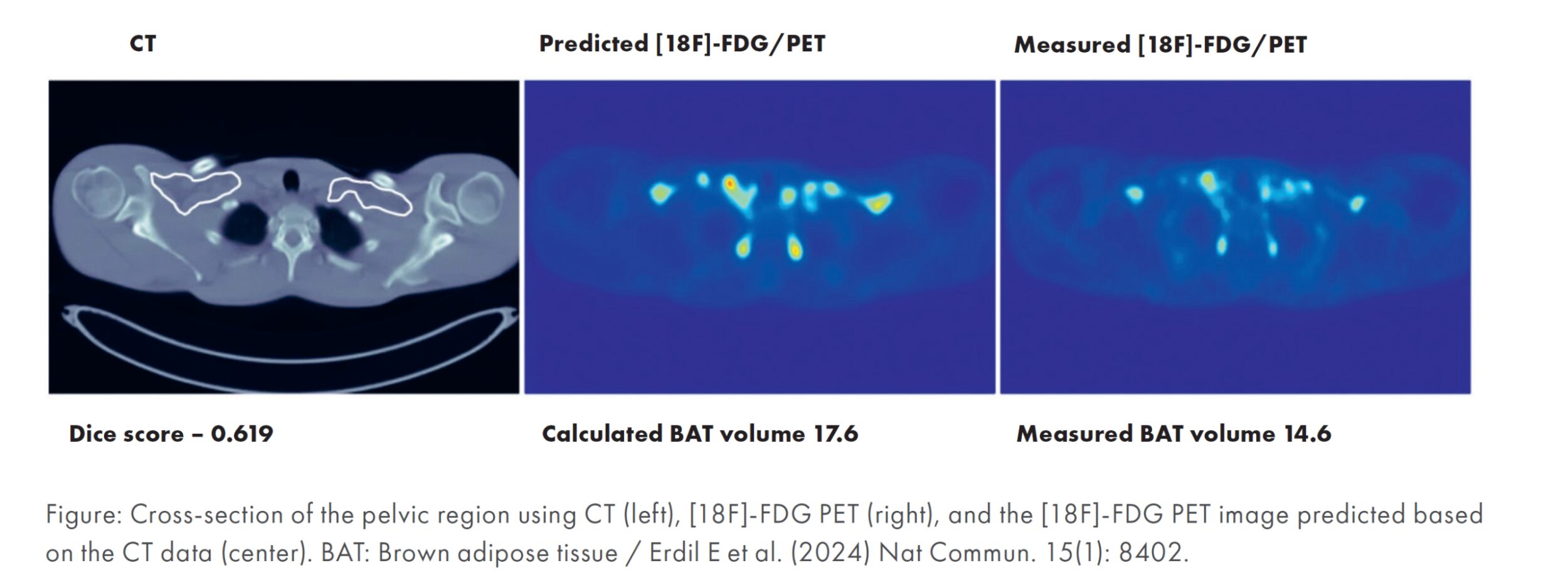
Imaging innovations represent another important part of our work. We developed specialized MRI techniques to quantify fat distribution in muscle tissue and designed machine learning-based methods for automatic body fat segmentation A particularly notable achievement was demonstrating that CT scans can deliver similar information to positron emission tomography (PET) scans in identifying metabolically active brown fat depots—without the need for expensive imaging using radioactive tracers. By applying neural networks, we showed that PET-derived glucose uptake measures correlate strongly with CT attenuation values, offering a more accessible and cheaper alternative for large-scale studies.
In the same period, the focus in imaging has shifted from method development to deployment and scaling. The automated analysis pipeline for whole-body MRI is now installed at the University Hospital Zurich and continuously processes incoming scans to quantify body fat distribution in a largely automated fashion. In addition, a new 3D registration algorithm based on modern “foundation” image models has been developed and benchmarked, with the goal of further improving organ-level analyses. These tools will allow us to perform large-scale, standardized assessments of body fat composition and muscle fat infiltration, and to relate these imaging patterns to clinical outcomes in the LOOBesity cohort.