
INTeRCePT
Personalized Treatment of Blood Cancer
Oncology
Problem: High relapse rates and development of treatment resistance in blood cancer therapy
Goal: To reduce relapse rates through optimized treatment strategies based on the molecular signature of tumor and immune cells
Oncology
INTeRCePT in a Nutshell
Personalized treatment of blood cancer
- Analyzes tumor and immune cells from blood cancer patients at the single-cell level
- Uses this to develop a simple clinical test: the INTeRCePT assay
- Goal: 50% more patients respond to their therapy
- 2025: a globally unique dataset with more than 1,000 samples from 200+ lymphoma patients
Despite modern therapies, many patients with blood cancer relapse or develop resistance. INTeRCePT aims to change this – by taking a close look at the molecular diversity of tumor and immune cells.
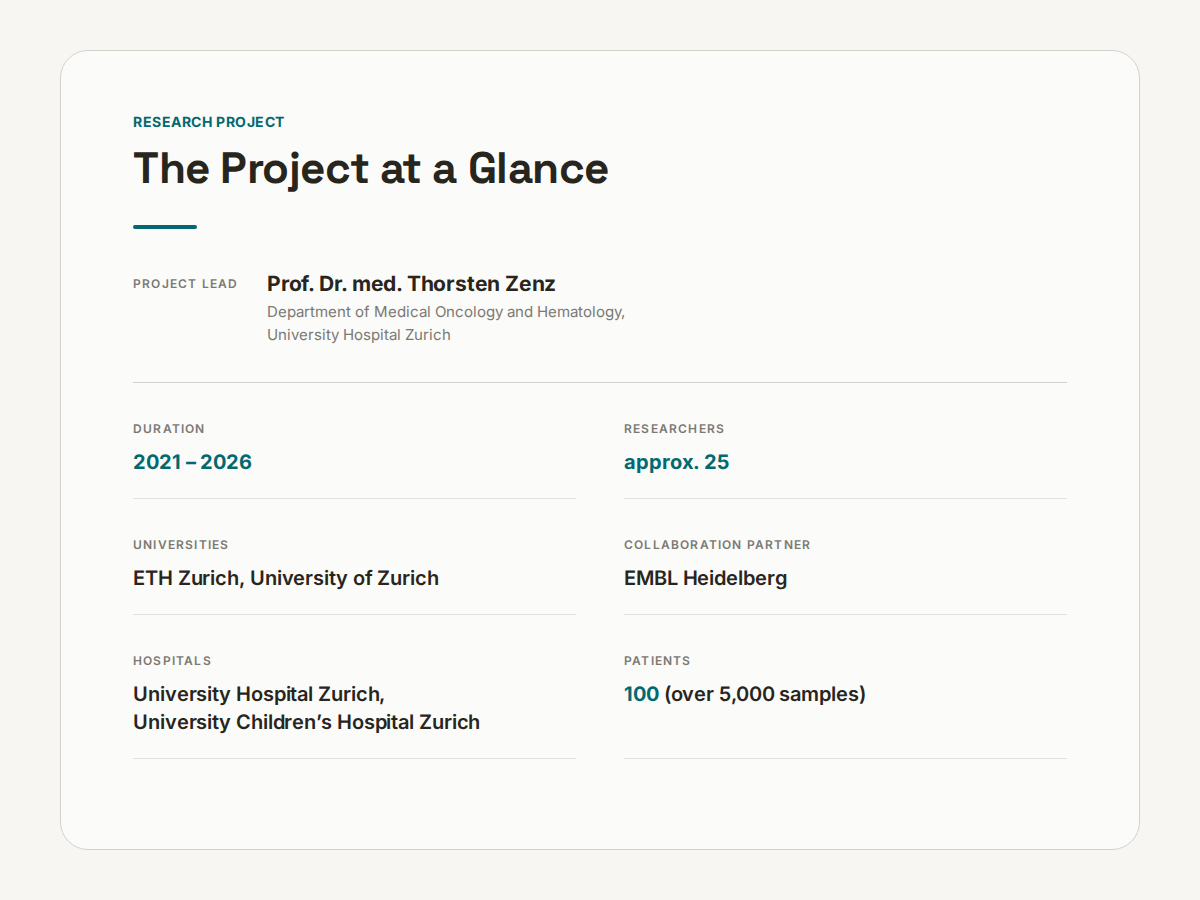
To this end, the team led by Thorsten Zenz (University Hospital Zurich) has set up an “innovation clinic” in Zurich for patients who have relapsed. Analyzing tumor cells and healthy blood cells at the single-cell level produces a detailed map of treatment response – the basis for a new, much simpler test: the INTeRCePT assay. Despite its reduced complexity, it is designed to provide oncologists with all the relevant information. The goal: 50% more patients respond to their therapy.
In 2025, a globally unique dataset was built for this purpose: more than 1,000 samples from over 200 lymphoma patients, including patients receiving CAR T-cell therapies. The first prognostic biomarkers have already been identified. In 2026, the last patients will be recruited for the INTeRCePT 2.0 study – laying the groundwork for the follow-up study INTeRCePT 3.0.
Significance for Medical Research
INTeRCePT’s precision medicine concept has proven so effective in advancing precision oncology that the follow-up project INTeRCePT 3.0 was launched on its basis. The detailed analysis of dynamic changes in tumor cells and their molecular response to treatment provides important insights for planning individualized therapies across a broad spectrum of cancers.
These insights feed directly into the development of optimized treatment approaches and help to further improve the success rates of cancer treatments. With INTeRCePT and its follow-up project INTeRCePT 3.0, Zurich is also gaining an international profile.
Associated Project: Helmut Horten Anniversary Project
Oncology
The Consortium

Thorsten Zenz, University Hospital Zurich, Department of Medical Oncology and Hematology.

Burkhard Becher, University of Zurich, Institute of Experimental Immunology.

Niko Beerenwinkel, ETH Zurich, Institute for Biomedical Engineering.

Jean-Pierre Bourquin, University Children’s Hospital Zurich, Oncology.

Wolfgang Huber, EMBL Heidelberg.

Stefanie Kreutmair, University Hospital Zurich, Department of Medical Oncology and Hematology.

Andreas Moor, ETH Zurich, Department of Biosystems Science and Engineering .
Berend Snijder, ETH Zurich, Institute of Molecular Systems Biology.